Spy Hunter

With its smart weapons, awesome cars, Spy Hunter was viewed as a very stylish game back in the arcades on the early 1980s. It was a title that playing into any boy's fantasies- secret agents, nasty weaponry, and a driving lincese. Make no mistake though, it was the action packed gameplay that kept people coming back for more again, again, and again...

1943

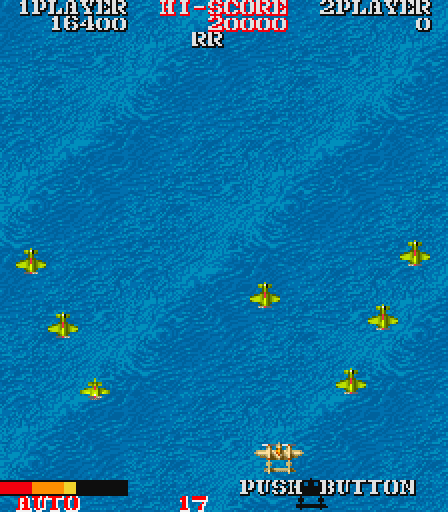
The year that the war ground on may have been 1943, when rationing continued to bite down hard, construction work on the Pentagon was completed, and the Japanese forces were driven back from Guadalcanal, but it's a whole lot more enjoyable if you think of it as this wonderful little vertical-scrolling shooter from Capcom, released for the delight of the arcade-going populas in 1987...

Diablo

The game isn't just a good looking isometric dungeon crawler, it is THE best dungeon crawler. A simple - almost brainless trek through caverns and catacombs filled with vile creatures, not to mention all the loot. Blizzard spent a lot of time working on the generation of the game's spaces, making items, enemies, and geography be different every single time you load up the game...

The Elder Scrolls III: Morrowind

The Elder Scrolls games are best known for the fourth chapter in the series, Oblivion, released in 2006. In comparison,The Elder Scroll's Morrowind is altogether more of a curate's egg, neither as commercially successful nor critically applauded as it's successor. Perhaps because of that, however, it's also a much more interesting game...

Rogue

Rogue first appeared on college Unix systems in 1980. It contains an infinite variety via a series of randomly generated, ASCII-rendered dungeons that must be explored in a bid to retrieve the Amulet of Yendor (Rodney spelled backwards) from somewhere behold the twenty-fifth level -- an unlikely achievement given the imposing difficulty of even the earliest dungeon layers.

Showing posts with label Shoot 'Em Up. Show all posts

11 August, 2012

GoldenEye 007


  • Release Date: 1997
  • Platform(s): Nintendo 64
  • Developer: Rare
  • Genre: Shoot 'Em Up


You could argue that the title of Best James Bond Game ironically sits with a series that has nothing to do with James Bond, the Metal Gear series. Less debatable, though, is the holder of the title of Most Important Console First-Person Shooter. Before GoldenEye 007, and adaptation that played fast and loose with the 1995, many would struggle with even the idea of such a thing.

Unlike contemporary Turok: Dinosaur Hunter, GoldenEye 007 proved that joy pad controls were not a disability. Both games featured precision aiming thanks to the N64 analog stick, but Rare knew best how to use it. Revelling in the lack of hyper-kinetic PC controls, it made a game in which every shot felt like something handmade. Hit a shoulder, and an enemy might pirouette to the floor; the groin -- an natural favourite -- and they'd fold and keel over; the head, and they'd drop as if hit with a pole-arm. Games like Virtua Cop got there sooner but, to borrow a phrase, nobody does it better than Bond.

In single-player mode, GoldenEye 007 features a rarely emulated difficulty method that switched objectives at each level, making it highly replayable even now. But the game's split-screen support for up to four players, as much as a testament to the N64's hardware layout, was the proof of concept for all console multiplayers. When games like Halo try to capture that feeling via Xbox Live, what they are referring to is the sight of your armchair buddy being dropped by the Golden Gun, on of umpteen weapons and modes that kept this game going for years.

Culling gadgets and characters from the entire Bond universe, GoldenEye 007 pounced on every opportunity its license could afford.

15 December, 2011

Star Wars: TIE Fighter


  • Release Date: 1994
  • Platform(s): PC
  • Developer: Totally Games
  • Genre: Shoot 'Em Up


Star Wars: TIE Fighter features visceral space combat
It was perfect symmetry. Before making Star Wars: TIE Fighter, designer Lawrence Holland of Lucasfilm Games created a suite of World War II dogfighting games, including Secret Weapons of the Luftwaffe. For Star Wars' space dogfights, George Lucas looked to The Dam Busters and 633 Squadron for inspiration. When Holland was asked to think about creating a space combat game, he quickly realized that he and Lucas were already looking squarely at the same sources. The result was a series of games that represent some of the best file tie-ins ever created.

The secret is in the subtle blend of strict adherence to Star Wars lore and a willingness to design imaginatively on top of them. Immediately striking are the intense, twisting dogfights against star fields streaked with beams of bright, green and orange laser fire, as well as the iconographic lines of Star Wars' distinctive spacecraft. But the meat lies in one of gaming's most beautiful mechanics: your craft's power system. Demanding that you delicately balance your finite energy supply between lasers, engines, and shields, you are continually asked to think about how to approach each situation. Dump all your power into engines for speed, and you'll risk running out of lasers and having no protection when you meet trouble.

Star Wars: TIE Fighter, which has you fight for the Empire, features smoothly shaded fighters and meticulously designed missions. And though you might assume you'd always want to fight for the plucky Rebellion, the game's vision of dark political intrigue oozing below a veneer of mundane bureaucracy is gripping. It remains a terrible thrill to pilot a craft as fragile and feather-light as a regular TIE. Showing Star Wars from the dark side resulted in one of the most enthralling visions of its universe.

02 December, 2011

1943


  • Release Date: 1987
  • Platform(s): Arcade
  • Developer: Capcom
  • Genre: Shoot 'Em Up


The year that the war ground on may have been 1943, when rationing continued to bite down hard, construction work on the Pentagon was completed, and the Japanese forces were driven back from Guadalcanal, but it's a whole lot more enjoyable if you think of it as this wonderful little vertical-scrolling shooter from Capcom, released for the delight of the arcade-going populas in 1987.

The sequel to Capcom's cracking 1942, 1943 is set in the Pacific as the player fights off waves of oncoming enemies to take the battle to the heart of the Japanese fleet. Once again, victory depends on mastery of standard and special attacks, as you take down spinning, cycling, warping, and flipping waves of oncoming aircraft and ground troops, fighting elaborate boss battles and collecting brilliant power-ups. The health system has been modified somewhat, but the game remains as challenging as ever, and overall success is still as unlikely. (Although the introduction of two-player cooperative action evens out the odds a little, especially during the larger boss confrontations.) Like the previous title, 1943 is now considered one of the kings of the one-credit-play-through challenge, popular among a particularly hardcore group of the game's fans.

Having created the arcade iteration, Capcom handled a home version for the NES, but a cast and unwieldy range of ports across different platforms range widely in terms of quality and degrees of fidelity. Faced with such a compromised muddle, if you're itching to re-stage the Battle Of Midway in entirely unrealistic terms today, you'll probably want to hunt down the mighty Capcom Classics Collection -- a generous PS2/Xbox compilation -- which features this game, along with many other greats, and has some rather delightful menus to boot.

They just never stop coming