Spy Hunter

With its smart weapons, awesome cars, Spy Hunter was viewed as a very stylish game back in the arcades on the early 1980s. It was a title that playing into any boy's fantasies- secret agents, nasty weaponry, and a driving lincese. Make no mistake though, it was the action packed gameplay that kept people coming back for more again, again, and again...

1943

The year that the war ground on may have been 1943, when rationing continued to bite down hard, construction work on the Pentagon was completed, and the Japanese forces were driven back from Guadalcanal, but it's a whole lot more enjoyable if you think of it as this wonderful little vertical-scrolling shooter from Capcom, released for the delight of the arcade-going populas in 1987...

Diablo

The game isn't just a good looking isometric dungeon crawler, it is THE best dungeon crawler. A simple - almost brainless trek through caverns and catacombs filled with vile creatures, not to mention all the loot. Blizzard spent a lot of time working on the generation of the game's spaces, making items, enemies, and geography be different every single time you load up the game...

The Elder Scrolls III: Morrowind

The Elder Scrolls games are best known for the fourth chapter in the series, Oblivion, released in 2006. In comparison,The Elder Scroll's Morrowind is altogether more of a curate's egg, neither as commercially successful nor critically applauded as it's successor. Perhaps because of that, however, it's also a much more interesting game...

Rogue

Rogue first appeared on college Unix systems in 1980. It contains an infinite variety via a series of randomly generated, ASCII-rendered dungeons that must be explored in a bid to retrieve the Amulet of Yendor (Rodney spelled backwards) from somewhere behold the twenty-fifth level -- an unlikely achievement given the imposing difficulty of even the earliest dungeon layers.

Showing posts with label Capcom. Show all posts

15 August, 2012

Breath of Fire II

Release Date: 1994
Platform: SNES
Developer: Capcom
Genre: Role-Playing

Breath of Fire II is an RPG great on a console crammed full of them. Released on the SNES, it joins the likes of Secret of Mana, the Final Fantasy series, Chrono Trigger, and the original Breath of Fire at the very top of its chosen genre. It takes place 500 years after the end of the original game to tell the story of Ryu Bateson, a blue-haired boy hero on a quest for justice, which is launched when his friend is framed for a crime he didn't commit.

The game picks up the day/night cycle from its predecessor, which sees the world and its inhabitants transform with every sunset, and it features the turn-based, random encounters that are a staple element of the Japanese RPG genre. Picking the right formation is a crucial part of combat strategy, while another key feature is each character's special ability, such as Ryu's dragon transformations or Bow's fusion form as a giant, cannonball-launching mech.

One of the best things about the game is the way the world is gradually opened up. Each party member has a unique skill that they can use outside of the normal course of play, so fishing and hunting skills, for example, unlock different mini-games. But the ability to swim or bridge chasms allows the party to access more of the increasingly vast game world, and it's the pacing of exploration is one of the game's greatest strengths. Another is the way the game prefigures the Dark Cloud series by giving you the ability to build your very own town, choosing its architectural style, and gradually filling it with non-player characters that can help you on the main mission -- a mission with multiple endings, depending on how effectively you steer Ryu and friends on one of the classic quests of 16-bit storytelling.

02 December, 2011

1943


  • Release Date: 1987
  • Platform(s): Arcade
  • Developer: Capcom
  • Genre: Shoot 'Em Up


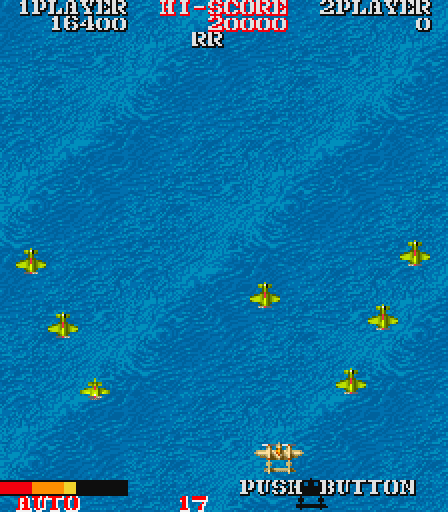
The year that the war ground on may have been 1943, when rationing continued to bite down hard, construction work on the Pentagon was completed, and the Japanese forces were driven back from Guadalcanal, but it's a whole lot more enjoyable if you think of it as this wonderful little vertical-scrolling shooter from Capcom, released for the delight of the arcade-going populas in 1987.

The sequel to Capcom's cracking 1942, 1943 is set in the Pacific as the player fights off waves of oncoming enemies to take the battle to the heart of the Japanese fleet. Once again, victory depends on mastery of standard and special attacks, as you take down spinning, cycling, warping, and flipping waves of oncoming aircraft and ground troops, fighting elaborate boss battles and collecting brilliant power-ups. The health system has been modified somewhat, but the game remains as challenging as ever, and overall success is still as unlikely. (Although the introduction of two-player cooperative action evens out the odds a little, especially during the larger boss confrontations.) Like the previous title, 1943 is now considered one of the kings of the one-credit-play-through challenge, popular among a particularly hardcore group of the game's fans.

Having created the arcade iteration, Capcom handled a home version for the NES, but a cast and unwieldy range of ports across different platforms range widely in terms of quality and degrees of fidelity. Faced with such a compromised muddle, if you're itching to re-stage the Battle Of Midway in entirely unrealistic terms today, you'll probably want to hunt down the mighty Capcom Classics Collection -- a generous PS2/Xbox compilation -- which features this game, along with many other greats, and has some rather delightful menus to boot.

They just never stop coming

24 September, 2011

The Legend Of Zelda: Oracle of Seasons/Ages


  • Release Date: 2001
  • Platform: Game Boy Colour
  • Developer: Capcom
  • Genre: Action / Adventure

The follow-up to the Game Boy's brilliant The Legend of Zelda: Link's Awakening was always going to have its work cut out, even before you consider that, for the first time, third-party developers were handling the most delicate of Nintendo's children. And although Capcom can't compete with the master company's own designers, it does a pretty decent job of playing babysitter to greatness, with a couple of games that certainly cover very suitable territory and repeat all the right moves.

The Legend of Zelda: Oracle of Seasons/Oracle of Ages are a pair of complementary interconnected games. The two games, released simultaneously, interact via a Nintendo Game Link Cable, enabling the two titles to be played on two different Game Boys at the same time. Each game transports our hero Link to a different magical land, where a powerful oracle has been kidnapped. While the larger story can only be understood when both games are completed, each title can still be enjoyed as a standalone adventure in it's own right. And, helpfully Capcom has been taking notes, with adventures that unfold in a familiar progression of item-gathering, over-world exploration, and dungeon crawling. It's not a bad copy of the previous games, and the development team manages to throw in enough new magical twists and ideas to keep you chugging along on a series of journeys that only just fall short of what Zelda fans traditionally expect.

With visuals and controls almost identical to The Legend of Zelda: Link's Awakening, the Oracle games never quite reach the heights of Nintendo's own work, though they still do a decent job. Heartfelt, varied and often clever, they serve as a reminder that the right property has the power to lift everyone associated with it.