Spy Hunter

With its smart weapons, awesome cars, Spy Hunter was viewed as a very stylish game back in the arcades on the early 1980s. It was a title that playing into any boy's fantasies- secret agents, nasty weaponry, and a driving lincese. Make no mistake though, it was the action packed gameplay that kept people coming back for more again, again, and again...

1943

The year that the war ground on may have been 1943, when rationing continued to bite down hard, construction work on the Pentagon was completed, and the Japanese forces were driven back from Guadalcanal, but it's a whole lot more enjoyable if you think of it as this wonderful little vertical-scrolling shooter from Capcom, released for the delight of the arcade-going populas in 1987...

Diablo

The game isn't just a good looking isometric dungeon crawler, it is THE best dungeon crawler. A simple - almost brainless trek through caverns and catacombs filled with vile creatures, not to mention all the loot. Blizzard spent a lot of time working on the generation of the game's spaces, making items, enemies, and geography be different every single time you load up the game...

The Elder Scrolls III: Morrowind

The Elder Scrolls games are best known for the fourth chapter in the series, Oblivion, released in 2006. In comparison,The Elder Scroll's Morrowind is altogether more of a curate's egg, neither as commercially successful nor critically applauded as it's successor. Perhaps because of that, however, it's also a much more interesting game...

Rogue

Rogue first appeared on college Unix systems in 1980. It contains an infinite variety via a series of randomly generated, ASCII-rendered dungeons that must be explored in a bid to retrieve the Amulet of Yendor (Rodney spelled backwards) from somewhere behold the twenty-fifth level -- an unlikely achievement given the imposing difficulty of even the earliest dungeon layers.

Showing posts with label 1980s. Show all posts

09 October, 2012

Desert Commander

Release Date: 1989
Platform(s): NES
Developer: Kemco
Genre: Turn-based Strategy

Desert Commander is one of the more complex turn-based strategy games for the Nintendo Entertainment System. Set in North Africa during World War II, the player chooses between commanding either the Allied Forces of George S. Patton and Bernard Montgomery, or the Axis Powers or Erwin Rommel. Similar to 1943, using this point in history informed the visual aesthetic of the game and simplified the vehicle design, a necessary compromise for the underpowered NES.


The game uses a top-down view for strategically placing vehicles and assets against the opponent, much like a board game. The player manages resources, helping to simulate the decisions that go into deployment of a military force. When an encounter between opposing sides ensues, the game switches to a close-up view of the battle. While it was a rudimentary view with limited animations, it created a design aesthetic that remains to this day, even with systems that are capable of sophisticated animation and photorealism. The abstracted landscape keeps a focus on the numbers engaged in combat instead of the surrounding visuals. Animated sequences were used to depict special actions, such as refuelling or the gathering of supplies.

Operating on a limited platform and dependent on utilitarian visuals, Desert Commander managed to build a sophisticated tactics game.

18 August, 2012

North & South


  • Release Date: 1989
  • Platform(s): Commodore Amiga, Atari ST, Commodore 64, DOS, MSX, NES
  • Developer: Infogrames
  • Genre: Action / Strategy

The American Civil War was surely not the most pleasant of wars. Wedged uncomfortably close to the nasty delights of industrialization, it was a muddle of shelling and gunpowder, in which people got their faces burned off, or were accidentally run through by their own side's sabres; it was a conflict in which troops were regularly trampled under horses, and that nice Kevin Costner almost had his leg lopped off and went to live with the Native Americans.

North & South tells a slightly cheerier story. A mixture of cold strategy and fast-paced battles, Infrogrames's classic is based on a Belgian comic called Les Tuniques Bleus. This means that verisimilitude was never going to be that high on the agenda. That said, beyond the chummy cartoon faces and quiky animated asides (you can tickle the photographer on the main menu screen by goosing him with your mouse pointer), it's still a smart tactical challenge all the same.

North & South operates in two modes. There's the overworld view, in which you move troops around a map of the United States, staking out territory and pincering your enemy. There's also a battle mode that allows you to race through enough stripped-down skirmishes more personally. pushing around a range of infantry, cavalry, and cannons.

The story moves at a pace while excellent audio and visual presentation give the whole thing a sheen of polish missing from many other games of the era. The ending sequence, in which weary troops march home, the war over, set new standards for animation at the time of its release. Taken as a whole, North & South, while not particularly deep, makes for a pleasant arcade strategy experience even today -- if you can track down an original copy and coax it back to life, that is.

24 December, 2011

Frogger


  • Release Date: 1981
  • Platform(s): Arcade
  • Developer: Konami
  • Genre: Action


In theory, you should never lose at Frogger. The gaming world's first frog superstar has a straightforward task: to get across a highway, and then a river -- dodging vehicles in the first stretch, jumping across logs and turtles on the second. The surrounding world is obvious to its struggle: The cars speed along on their own, and the alligators and poisonous frogs that patrol the river come and go regardless of where it hops. All you have to do is spot the path through the obstacles and complete it. If you find the right trail, you can make it in seconds. The whole thing should be a cinch, because only you can put yourself in trouble; the game hardly notices you're there.

Keep your head up.
That, however, is all easier said than done. Moving too quickly is one of the things that leads to mistakes. Panic is another. The obstacle course gets harder as cars speed up and sections of the river change their flow.  You're tempted to make a jump onto a turtle when you know it's about to sink underwater -- dragging you to your doom. And it's easy to get impatient around the slow-moving cars, even though the game counts you as dead if you hit the front or the rear. You're led to make errors by fearing your own vulnerability, by your eagerness to grab that difficult far-left berth on the safe end of the board, or by the chance to grab a fly for extra points.

A monster hit of the coin-operated arcade era, Frogger anticipates the pleasure of platformers like Super Mario Bros., and it appeals to players who would rather keep themselves alive than kill everything else around them. The frog's predicament draws the player into an environment that may be colourful and pleasing but is also full of threats. It's a place where shiny opportunities are put there to tempt you off the safe path, and where mastering the world breeds ridiculous joy.

02 December, 2011

1943


  • Release Date: 1987
  • Platform(s): Arcade
  • Developer: Capcom
  • Genre: Shoot 'Em Up


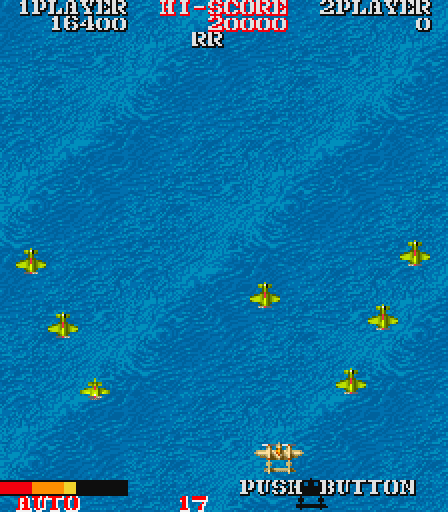
The year that the war ground on may have been 1943, when rationing continued to bite down hard, construction work on the Pentagon was completed, and the Japanese forces were driven back from Guadalcanal, but it's a whole lot more enjoyable if you think of it as this wonderful little vertical-scrolling shooter from Capcom, released for the delight of the arcade-going populas in 1987.

The sequel to Capcom's cracking 1942, 1943 is set in the Pacific as the player fights off waves of oncoming enemies to take the battle to the heart of the Japanese fleet. Once again, victory depends on mastery of standard and special attacks, as you take down spinning, cycling, warping, and flipping waves of oncoming aircraft and ground troops, fighting elaborate boss battles and collecting brilliant power-ups. The health system has been modified somewhat, but the game remains as challenging as ever, and overall success is still as unlikely. (Although the introduction of two-player cooperative action evens out the odds a little, especially during the larger boss confrontations.) Like the previous title, 1943 is now considered one of the kings of the one-credit-play-through challenge, popular among a particularly hardcore group of the game's fans.

Having created the arcade iteration, Capcom handled a home version for the NES, but a cast and unwieldy range of ports across different platforms range widely in terms of quality and degrees of fidelity. Faced with such a compromised muddle, if you're itching to re-stage the Battle Of Midway in entirely unrealistic terms today, you'll probably want to hunt down the mighty Capcom Classics Collection -- a generous PS2/Xbox compilation -- which features this game, along with many other greats, and has some rather delightful menus to boot.

They just never stop coming

22 November, 2011

Rogue


  • Release Date: 1980
  • Platform(s): Unix
  • Developer: Michael Toy, Glenn Wichman, Ken Arnold
  • Genre: Strategy / Role-Playing


Rogue first appeared on college Unix systems in 1980. It contains an infinite variety via a series of randomly generated, ASCII-rendered dungeons that must be explored in a bid to retrieve the Amulet of Yendor (Rodney spelled backwards) from somewhere behold the twenty-fifth level -- an unlikely achievement given the imposing difficulty of even the earliest dungeon layers.

Practically no information is disclosed to the player, so every new game is a voyage of discovery, not just the dungeon's layout, but also of the monsters and items within. Progression to the deeper parts of the dungeon is such a rarity that there are inevitably new monsters to meet. Quaffing potions and reading scrolls along the way is always a calculated risk; you might discover that you've just gulped down a potion of strength ("You feel stronger. What bulging muscles!"), but if you've guzzled a potion of blindness ("A cloak of darkness falls") you can kiss goodbye to any chance of surviving to the later levels.

Other obstacles include simple hunger, which can wipe out even the bravest of adventurers;dead ends; and a cruel variety of traps.

One of Rogue's Many Randomly Generated Dungeons (Click to Enlarge)

06 April, 2011

Super Mario Bros.


  • Release Date: 1985
  • Platform: NES
  • Developer: Nintendo
  • Genre: Platform


The problem with classics, is that they are old. They usher in great changes and they redifine the landscape, but less influential games perfect the trends they started and end up being a lot more fun to play. For example, StarFox isn't as ground breaking as Asteroids as far as space games go, but anyone stuck in an elevator would undoubtedly prefer it as a means to pass the time.

And yet, while Super Mario Bros. did so much to define the side-scrolling platformer, twenty-odd years on its still one of the best there is. It's colours may seem a little muted by today's standards, and its ironic plumber's mustache lacks definition, but this has excellent enemy design, tricky, secret-packed worlds, and an unforgettable soundtrack.

Most of all, Super Mario Bros. has a sense of believable physics - something still missing from modern day platformers. Set Mario running, and you'll need time and space to get him to slow down; attempt a big jump, and you're going to have to get a running start; bounce on an enemy, and you may still need to fine tune your landing while still in the air. All of which gives the game the precision necessary to allow for a cluster of tightly paced underground and overworld levels, with their gloriously destructable environments and famous power-ups, like the growth mushroom and the fire flower. Super Mario Bros. is venerable, then, but not remotely rickety: a simple delight that can still give far more complex games a comprehensive run-around.


23 January, 2011

Spy Hunter

  • Release Date: 1983
  • Platform: Arcade
  • Developer: Midway
  • Genre: Action
With its smart weapons, awesome cars, Spy Hunter was viewed as a very stylish game back in the arcades on the early 1980s. It was a title that playing into any boy's fantasies- secret agents, nasty weaponry, and a driving lincese. Make no mistake though, it was the action packed gameplay that kept people coming back for more again, again, and again.

In Spy Hunter, you play as a secret agent with a car that shoots bullets from the front grill, and you are tasked with the simple task of mowing down countless amounts of enemies on an endless, linear highway. From stretch cars with side-machine-guns, to buses with spiked wheels, and even the occasional helicopter,  Spy Hunter had a unique and incredible selection of foes to destroy. Even upgrading your ride was cool; driving into the back of passing vans to upgrade your car with smoke-screens and oil slicks every now and again.

All of this was pretty slick, but Spy Hunter's most epic moments comes when the game's incomplete bridges force you to take your ride off-road, where it transforms itself into a boat, and taking the road based battles to the sea.

Fit to the obsessions of the 1980s, having a mixture of espionages and cars, Spy Hunter is a delightful memory for everyone who played it.


18 January, 2011

Donkey Kong

  • Release Date: 1981
  • Platform: Arcade
  • Developer: Nintendo
  • Genre: Platformer
Donkey Kong was truely a game-changer (no pun intended)  when it was first released back in 1981. It's elaborate cartoon graphics set it apart from the industry standard of a scene filled with aliens and space rocks. It came at a time where the "great" protagonist was merely a yellow circle who seemed to suffer from a chronic drug addiction.The game had decent animation when other games had blips that just moved around the screen.

It also introduced two characters who would go on to dominate the gaming realm for years to come. As welll as Donkey Kong, we were introduced to a carpenter named Jumpman. After a name change and a career transition, Jumpman would go on to become one of the most iconic characters in gaming to date - Mario the plumber.

All of the mechanics that made the Mario games so successful, originated from this title. Leaping from platform to platform whilst dodging obstacles, on an endless quest to save his woman.

Donkey Kong launched Nintendo into the God-tier of game development. The company's president Hiroshi Yamauchi made the right decision in tasking the young employee Shigeru Miyamoto to crack into the US gaming market. It still a fun game to play today!